I live in a railway town and see a lot of trains. Our town is on a major north/south freight route so there are always long container trains or minerals trains passing through, as well as the fast electric trains to London, Bristol and Wales.
Trains can be passing by or standing still in the sidings that you can see from the station platforms. They are so familiar and constant that they seem ordinary, and I don’t usually pay much attention to them. Except for this morning, where I found myself enchanted by Sffggmrrs and wondering what it might mean.
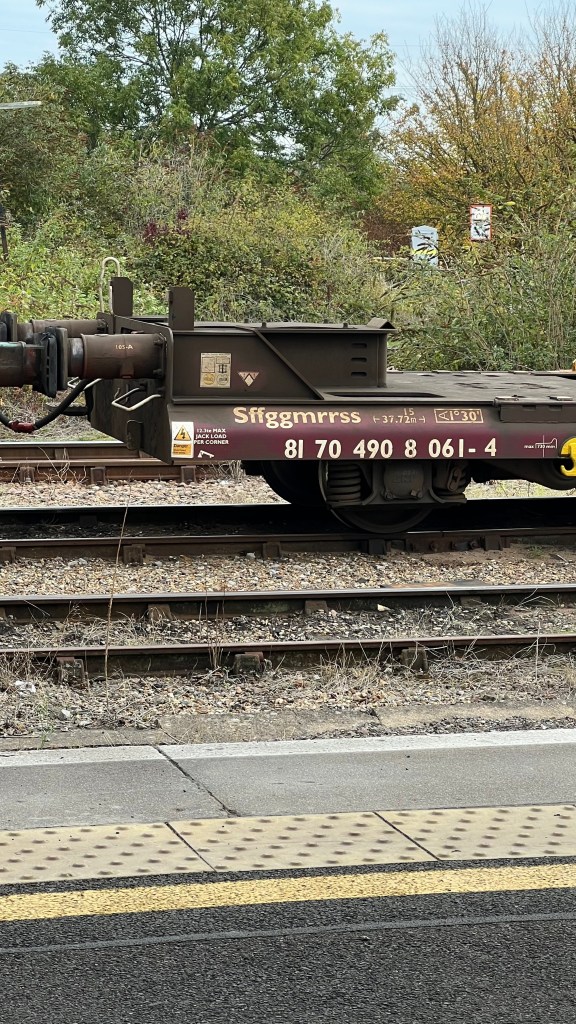
Megafret
The thing with this name is that it looks very much like a word, and yet the letter combinations are not common together in any language, so intrinsically you know that it’s not really a word.
I threw it into Google, and quickly found the triumphant marketing of VTG, a rail freight logistics company.
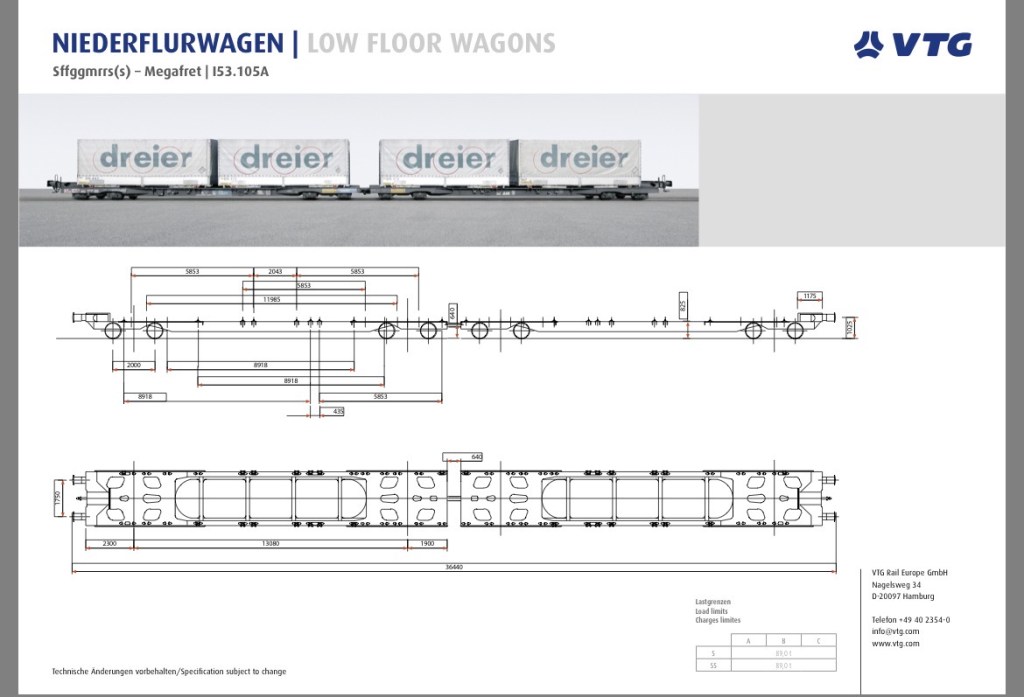
Sffggmrrs(s) “Megafret” | VTG type I53.105A
Low floor wagon
One of the most advanced railcar designs for use in combined traffic.With a loading deck height of only 825 mm it is possible to transport 9‘6“ containers (Highcube) through the Channel Tunnel into European terminals.
It is possible to transport containers and swap bodies with an exterior height of 3‘220 mm in a C-45 loading profile.
European Union Agency for Railways
After a bit more hunting, it turns out the EU has helpfully categorised all types of train wagons and the letters that you should write on them.
Specifically, Decision 2007/756/EC – Decision (EU) 2018/1614 Appendix 6,
Part 12.2 Letter marking for wagons for articulated and multiple wagons, page 21.
Despite the dry presentation, it gives a real insight into how to carry all sorts of things on a train, and make sure, for example that your freight won’t get stuck in a tunnel.
Decoding Sffggmrrss
Some of the letters are general codes, and some are specific. So decoding the letters:
- CATEGORY LETTER: S – FLAT BOGIE WAGON.
- ff – suitable for traffic with Great Britain (by tunnel exclusively)
- gg – fitted for the transport of containers, total loading length more that 20 metres
- m – with 2 units, each unit more than 27 m long
- rr – multiple wagon – ie there are 2 or more parts joined together into one whole wagon
- ss – wagons authorised to run at 120 km/h
So Sffggmrrss is a low floor container carrying wagon, in two parts, that can go at 120 km/h through the channel tunnel.
I guess if you work regularly on the railways, it’s a breeze to remember all the codes!

Other wagons
Just in case you were wondering…
- CATEGORY LETTER: E – OPEN HIGH-SIDED WAGON
- CATEGORY LETTER: F – OPEN HIGH-SIDED WAGON
- CATEGORY LETTER: G – COVERED WAGON of ordinary type with at least 8 ventilation apertures
- CATEGORY LETTER: H – COVERED WAGON of special type with 2, 4,or 6 axles
- CATEGORY LETTER: I – TEMPERATURE-CONTROLLED WAGON refrigerator wagon with class IN thermal insulation, with motor-driven ventilation, with gratings and ice bunker
- CATEGORY LETTER: K – 2-AXLE FLAT WAGON of ordinary type with drop sides and short stanchions
- CATEGORY LETTER: L – 2-AXLE FLAT WAGON of special type fitted out for the transport of motor cars, with or without decks, or fitted out for the transport of steel coils
- CATEGORY LETTER: O – MIXED FLAT AND OPEN HIGH-SIDED WAGON
- CATEGORY LETTER: R – FLAT BOGIES WAGON
- CATEGORY LETTER: S – FLAT BOGIES WAGON
- CATEGORY LETTER: T – WAGON WITH OPENING ROOF with bulk gravity unloading, on both sides, simultaneously, at the bottom or top
- CATEGORY LETTER: U – SPECIAL WAGONS
- CATEGORY LETTER: Z – TANK WAGON for food and chemical products, or for the transport of gases under pressure, liquefied or dissolved under pressure
 Martyn James Bull
Leave a comment