Martyn James Bull
In its short life, Wordle, the online word puzzle, has swept across the world. The puzzle’s success lies in deep learning design principles built into its fabric.
Released in October 2021, the soothing daily ritual of Wordle gained millions of fans around the world becoming such a phenomenon that the New York Times bought it from creator Josh Wardle and rated as the best game of 2022 by Slate.
The simple rules (guess a five letter word in six tries), zero cost to play, a new game every day, and and easy way to share results on social media are some of the reasons behind its success.
Free, fun, and simple
In an era of endless ad tracking cookies and signup forms, it’s refreshing to just visit a website and start playing a game.
With a simple, elegant interface, anyone can play on any device. For first time visitors, Wordle’s instructions take just 67 words to tell you everything you need to know to start playing immediately.
You can only play Wordle once a day and it’s the same game for everyone playing that day. One word each day, changing at midnight. Once you’ve used your six guesses for the day, that’s it, you’re done until tomorrow.
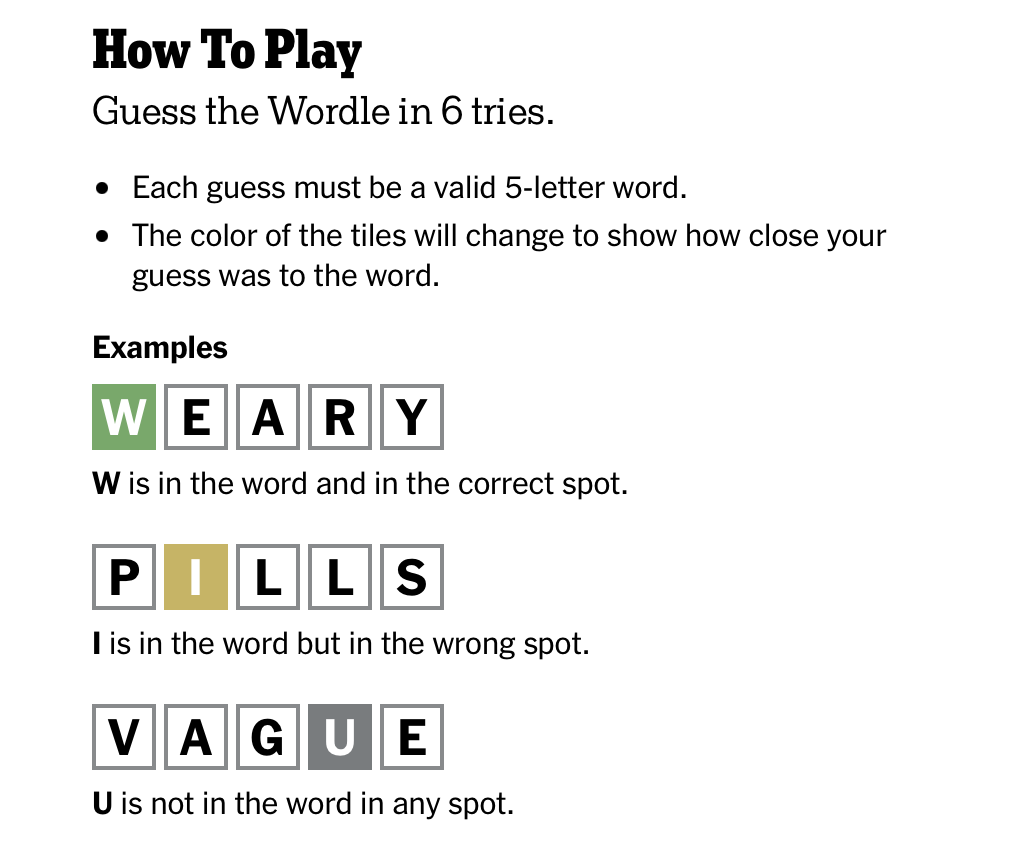
How to play
There aren’t any clues upfront, so any five letter word will do as an initial guess. That’s where the game of Wordle really starts. When you send a guess along, the colour of each letter changes.
Wordle achieves near zero time to fun. It’s a strong metric to keep in mind for any online experience. The longer the time to fun, the higher the frustration and user dropout will be. You should always aim to clear the junk out of the way of your learning experiences, and let users get on with the fun.
On top of that, Wordle doesn’t want to have an intense relationship with you.
The game design deliberately rejects revenue making and attention grabbing techniques to keep you in the infinite feed.
“I think people kind of appreciate that there’s this thing online that’s just fun”
– Josh Wardle
“I think people kind of appreciate that there’s this thing online that’s just fun,” said Wardle in an interview with the New York Times. “It’s not trying to do anything shady with your data or your eyeballs. It’s just a game that’s fun. It’s something that encourages you to spend three minutes a day. And that’s it. Like, it doesn’t want any more of your time than that.”
Desirable difficulty
Wordle really wants you to win. But with just a little bit of effort.
The choice of five letter words is a good one. Any shorter, and the words are too easy. Any longer and the words become less well known, and easier to guess due to more repeating letters. It’s right in the sweet spot to encourage you to think “I can have a go at that”.
A list of all of the five letter words in the English language runs to around 13,000 words, and contains a lot of obscure words that for most people would be near impossible to guess.
But in the game, that huge list of words has been narrowed down to about 2,500 commonly known Wordle words, with the rest allowed as guesses.
This careful sifting means that you have a good chance of success, but it is still challenging enough to trigger encoding and retrieval processes that support learning, and longer term retention of new words and understanding of letter combinations.
Feedback guides you towards the right answer
There isn’t a huge consequence for being wrong in Wordle. It rewards every thought you bring to it with something new to think about.
Effective feedback attaches meaning to thinking, even incorrect thinking, giving you information that helps you move forward. (Unlike those infuriating online experiences that give you no feedback at all or just tell you you’re wrong.)
Wordle uses a simple feedback by colour on letter positioning, that lets you know how close you are, and guides you towards your next guess.
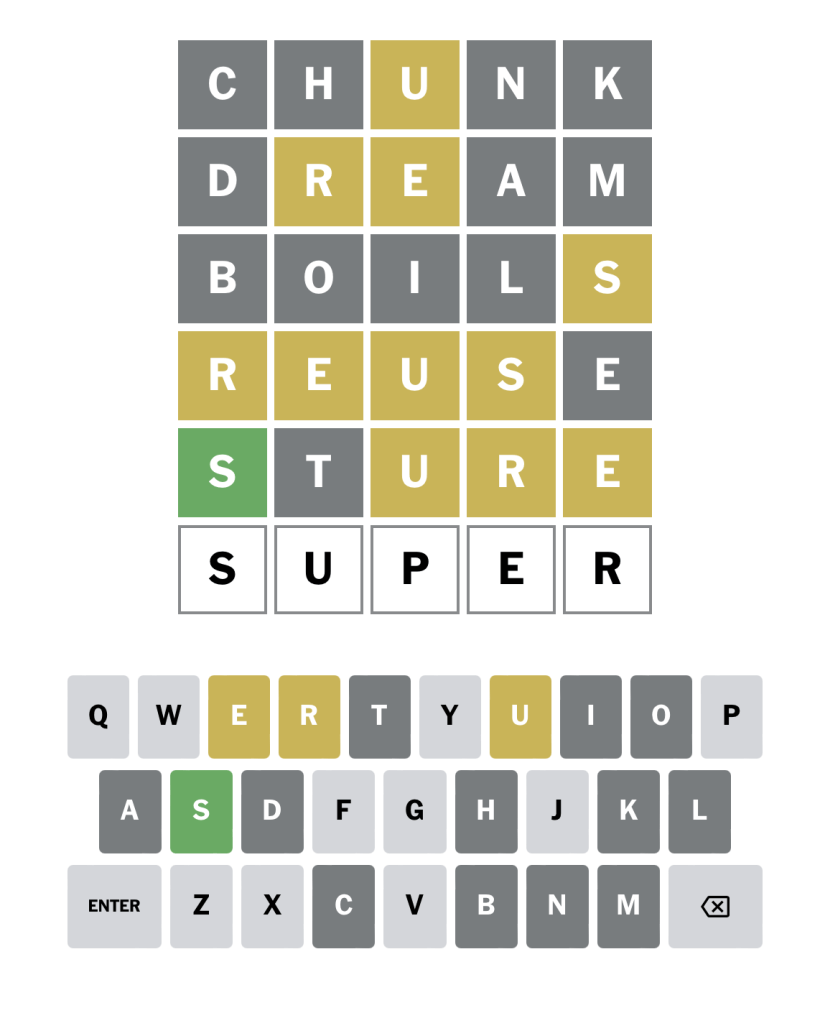
Another subtle feedback feature is the change to the keyboard keys to reflect the letter states. This helps the user keep focus on thinking, and avoids cognitive load moving back and forth between the grid and the keyboard. It’s a nice, simple way to ease people on.
Once the correct word is guessed, Wordle’s last flourish is its congratulatory message. It’s always positive, and has a good sense of humor: ‘Genius’, ‘Magnificent’, ‘Impressive’, ‘Splendid’, ‘Great’, and if you only succeed on your sixth guess, ‘Phew’.
Retrieval practice
Wordle is often compared to crosswords, but the mental process of solving is closer to code-cracking.
Once you’ve got past your first guess, players use their knowledge of spelling conventions and sound patterns in English to solve the word
Letter frequencies in English famously follow the ETAOIN SHRDLU order and since the game is based around five letter words, the words almost always involve consonant clusters.
‘ng’ is pretty common in English, but never at the beginning of a word, and “lng” never appears anywhere. ‘spl’ and ‘spr’ are common, for example, but “slr” or “prl” are impossible.
You have to have a gut feeling for which sequences are possible where, and which aren’t allowed at all, and to keep them in mind as you play.
Memory is the residue of thought, and the retrieval practice and pattern matching needed in each Wordle game to bring knowledge from long term memory into working memory is a great example of the learning process in action.
Shared experience
With everyone playing the same game at the same time, an unexpected joy of Wordle is the value of the shared experience, bringing people together in unexpected ways.
With so many different routes to the same answer, there are endless possibilities for fascinating conversations as people safely share how they think.
Wordle’s simple emoji sharing tool lets everyone know how you got on, but doesn’t give the game away. And if you don’t know what those little squares are, there’s a bit of mystery to figure out what everyone else is doing.
⬜⬜🟨⬜⬜
⬜🟨🟨⬜⬜
⬜⬜⬜⬜🟨
🟨🟨🟨🟨⬜
🟩⬜🟨🟨🟨
🟩🟩🟩🟩🟩
Communities around the world are comparing notes on solving strategies. Friends and family are connecting through group chats and social media, and it provides a really easy way to touch base with others.
One family, finding it hard to connect with their teenage son, found that Wordle is something the father and the son can do together each day.
Others say they feel a social connection through Wordle that is unlike any other digital learning experience they can remember – “one that is stronger than even many in-person learning experiences.”
And a missing game of Wordle even helped end a 17- hour hostage ordeal. Not bad for a little game built for lockdown fun.
“One family, finding it hard to connect with their teenage son, found that Wordle is something the father and the son can do together each day. ”
Originally published 14 April 2022.
Rebuilt here in 2024 after the publisher website was taken offline.
 Martyn James Bull